Sunday, May 9, 2010

Picture Post

Here are just a few random picture tidbits to keep your mind occupied. The lazy man's blog update.
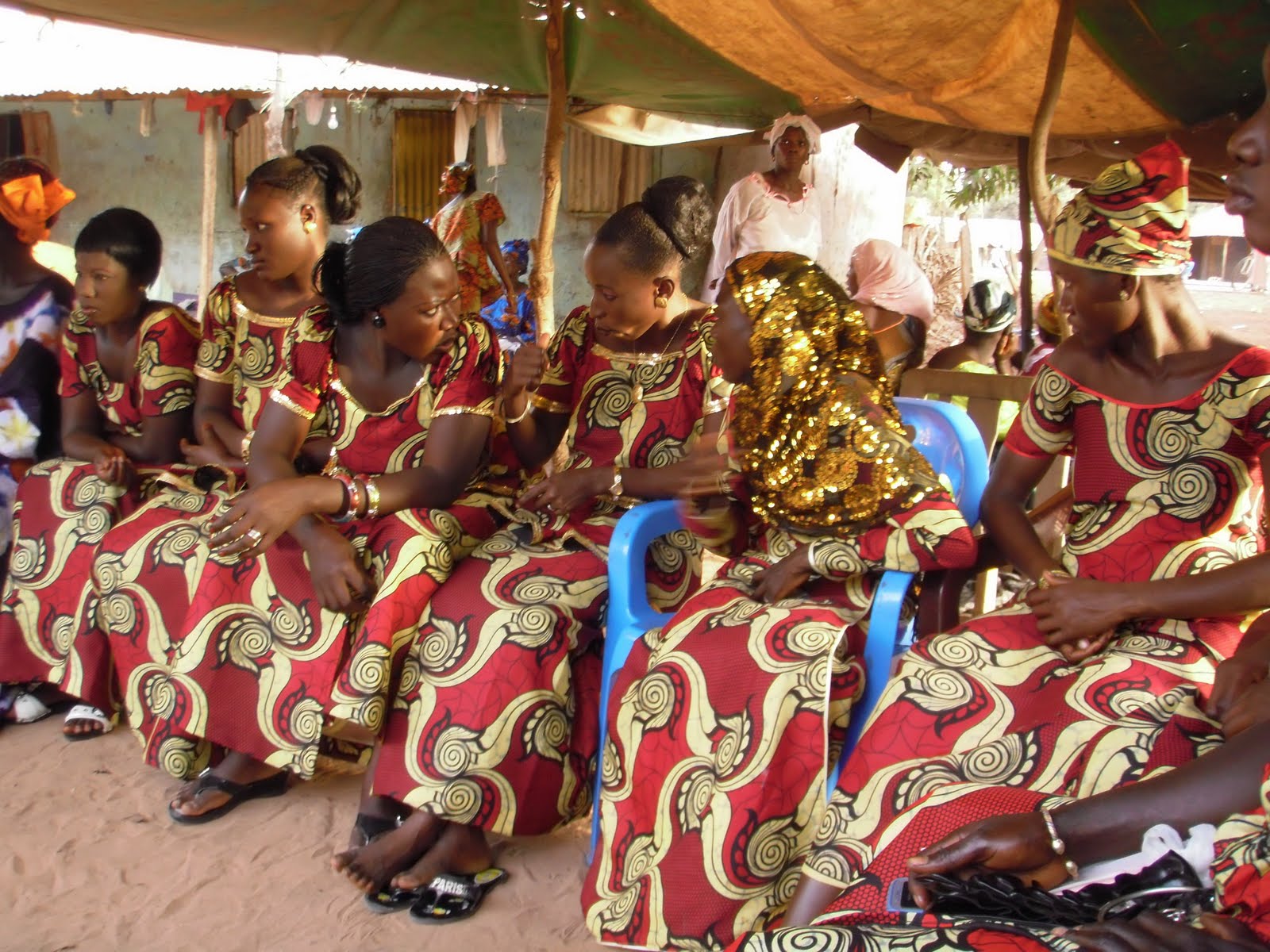
Add Image These are some of the girls from my tekla. We had asobe made. I'm sure I've told you before matching outfits are all the rage. We've been wearing it like crazy around town, but sadly no one has the photography skills to include me in a decent picture. Use your imagination.

This is a big ol' pot of benachin at the Konteh Kunda naming ceremony, where both my toma and my mom's toma, plus two more kids who have no special toma-relationship with me, got to celebrate themselves.


Matching outfits again! These are Western Region PCVs at the All Volunteer conference. If you're not matching, you're not in the in crowd.

Sunday, April 11, 2010

Interhouse

I don't know if I wrote a post about this last year, but interhouse is one of my very favorite Gambian events, and I can't let it pass unnoticed (okay, well it already passed, but better late than never, right?).

What is interhouse? Only the finest modern childrens sporting event in West Africa. At interhouse, the Upper Basic School divides itself into four houses, sort of like Harry Potter. This year the high school in the next village also competed, so we had a total of five teams. Then, they all run races and do other track and field-type events. (Side note: they also do this at the lower basic school, but instead of foot races, they do relays like the "carry a bucket of water on your head" race. Hilarious.)

What makes interhouse so amazing is the drama. This isn't any old American-style tournament. In this competition, if you're losing the race you might as well dramatically pass out in the middle of the track, showing the audience how difficult running 100 meters truly is. There are no losers, only drama queens.

When a competitor passes out, it's the job of the Red Cross Club to run to them with the stretcher. As you might imagine, the Red Cross Club was very busy. In each race, they had at least one person they needed to put on the stretcher. The "exhausted" racer would lie in the stretcher for a minute, and then be cured.

I worked at the judges table for interhouse, recording which teams won the races. Runners would come with cards showing how many points they got for each race, then as soon as they gave the cards to the judges they would collapse and roll in the dirt, practically having seizures to show you how exhausted they are, until they get up and straighten their wigs out. That's right, the girls run in their fancy wigs. You have to look smart for interhouse. All the girls who just come to watch wear their western-style made-in-China best. This means tight tight tight plaid jeans, synthetic tops, and other clothing items that might have them mistaken for street walkers in America. But in Gambia, they're looking smart. And the runners also take the opportunity to show off, running in miniskirts and other "work out" gear. A little bit of running, a lot of high quality performance art.

Friday, March 19, 2010

Tekila: A biweekly dance party

A few months ago a few of my friends in village told me they were organizing a Tekila, and I decided to join for the many perks it includes. A Tekila is sort of like an old-fashioned lottery/savings account mixed with a dance party. My group is made up of 35 girls about my age (which means that I'm basically one of the few not toting around a baby) who get together on the first of the month and on the 15th for an hour of drinking attaya and juice, singing and dancing. For me, it's a great way to get more integrated with a part of my village I don't really work with, and therefore don't know as well. For about two hours every two weeks, we shake our butts and bang on plastic bidongs in celebration.

The point of the Tekila isn't just to dance. When the group was formed, we all wrote our names on slips of paper. At every meeting, one name is drawn. This person is the lucky recipient of the prize money. Each girl contributes 25 dalasis each meeting, which means that when your name is drawn you get a lump sum of 875 dalasis. If you do the math, over the course of all the meetings you contribute exactly as much as you win, so you're not really coming out on top. But in this society saving is really hard, so while it's easy for each woman to find 25 dalasis to pay every two weeks, it would be rare to find someone who saved that 25 dalasis on their own initiative until they had 875 dalasis. So this is like tricking the women into saving. Keep contributing 25 dalasis, and at some point you'll find a large sum of money in your pocket. The women can do whatever they want with the money. Their only commitment is to host the next meeting at their house and supply the snacks and beverages.

The funny thing about my Tekila is that every single time, without fail, at least one hour of the meeting is spent arguing over how late fees should be charged, how many meetings you're allowed to miss, blah dee blah blah. Always the exact same subjects each time. Nothing is ever done, and frankly nothing really needs to be done because everyone pays up eventually. But it's tradition. We have a Tekila mother who is supposed to iron these things out and remind us that we came to party.

And party is in fact what we do. Everyone sits in a circle and people bang on various cooking utensils converted into instruments. Every girl is supposed to dance a few times in the middle of the circle during the meeting (which at first was kind of embarassing for me... I can dance in a club, but dancing African-style while someone bangs on some pastic with a stick is a little beyond me. I got over it though. I had to.). Some of the ladies are pretty bad dancers, but there are a few who can really shake it. African dancing is all about jumping up and down and sticking your butt out. One girl named Kaddy is the best. We had some excitement at the last meeting when she was dancing in the circle and her bin-bin broke. Binbin are basically a sexual accessory that every single Gambian woman wears. It's a string of beads your wear around your waist and the bigger they are, and the more they clack together, the sexier it is. But no one is ever supposed to see your bin-bin, and it's pretty scandalous if someone's are showing. Kaddy's bin-bin broke as she was dancing and beads just rained down out of her skirt. It was like a pinata, with all the (few) single ladies rushing to pick up the beads. Turns out collecting fallen bin-bin beads is a good luck charm, like catching the bouquet at a wedding. My friend Hawa collected a bunch because she wants to get married now now. A lot of the girls gave their beads to me... Not sure how I feel about that really.

Cross your fingers that I win the money the next time. I'm getting anxious for some profit!

Thursday, February 11, 2010

Workshops: More like shopping, less like working

I've been ruminating the deep internal flaws of the development system in this country for the past year or so, and in a horribly dramatic turn of events yesterday I faced an excellent illustration of the problem. I've been working with the farmers in my village to organize themselves when they sell their cashews so that they can have more bargaining power and hopefully oust the middle men buyers completely, selling as a block to the major exporters. We've had a lot of really excellent support from one NGO in particular, who has helped us write a constitution for our association, gotten the farmers to understand the possibilities of the cashew business, and provided some really great resources for us as a village. One of the activities this NGO has decided to carry out in the long term is a sort of ripple-effect education system, where villages choose several people to represent them at workshops, and those people are then responsible for bringing the information back to the village and teaching the farmers in an organized way the things they learned. It's a great idea, and I see a lot of potential in it. My village selected two really capable, smart men to represent us, and off we went to our first workshop to see what we would learn (I went too, just to see what they were learning so I could help where I could).

In the Gambia, there is rule, precedent, law - I'm not really sure which it is, depends who you ask - that people at workshops should be compensated for their time. So while in America you might pay to go to a workshop to learn interesting and valuable skills, here you get paid to attend. In theory, this should balance the scales, allowing people who can't afford to close shop for a day to have the same opportunities as everyone else. In reality, it has morphed into a culture where people go to as many workshops as they can, not to learn the information, but instead to eat meat, drink soda, and pad their pockets with cash. Not only that, they have come to see their per diem not as a welcome bonus, but as an inalienable right and if it is not high enough, then they will not bother.

Do all people feel this way? Certainly no. At this particular workshop there were several groups of people from different parts of SeneGambia, and it was clear that certain groups were intent upon exploiting the system, while others were content to be there and learn what they came to learn. Anyway, there were lots of interesting items on the agenda, but the first thing was determining per diem. The NGO's offer: 100 dalasis a day (this is including all meals, lodging, and transport costs and in my opinion is totally reasonable based on the average Gambian salary. Heck, it's even generous based on my own salary). The counter offer (from the vocal crowd): 700 dalasis per day. This is incredibly exorbitant. If per diem is to compensate you for the time you are not able to work, then people are saying that every day they were not at the workshop they would be making 700 dalasis. If this were true, each person would be making about 11,000 dollars a year. Just to put this in perspective, I make 2,000 dollars a year, and my salary is fairly high compared to most people in this country. I can live well, go on trips, and buy cheese when I want it.

The organizers of the workshop, in an incredible show of patience, said that they would take the offers back to the big boss and see what she had to say. Obviously, she said no way, and they came back with an offer of 250 dalasis. My issues with this: By making per diem negotiable, they are essentially exacerbating the problem. People see that they have the power to hold up workshops and demand money from people who are there to try to help them, and they continue to exploit this. The people still weren't happy, and day 2 of the workshop erupted into argument. Lots of people were sitting quietly, wishing the argument would end so we could get on with it. Already hours and hours of our time had been wasted by this particular group of people. Finally, I thought to myself, I should really say something. So here is what I said:

This NGO has given us a good offer. For everyone in this room, the money that they are offering is a good amount. We came here to learn. We came here for knowledge. We came here to represent our villages and do what has been asked of us. We can't waste more time arguing. We need to save the arguments for an appropriate time and get on with learning.

An important note: Since this workshop was attended by various groups of people from both Senegal and Gambia, it was held in Wolof, a language which I don't speak but which most of the other people in the room do. So a certain man who works for a certain association in a certain large village and has a certain corrupt and arrogant aspect to his personality translated into Wolof for me. I'm not sure what he said, but it definitely wasn't what I said. The response from the crowd: Shouting that they were not poor, that they have taught at my universities, that I was no one to tell them such things. Hmmm... something was obviously lost... or added... in translation.

At this point, I left the workshop. Not only was time wasted, but I felt really disheartened by people in general. It's sad to think that people can't see that they are being helped. That actually work against development because they want money in their individual pockets now. For a lot of people at that workshop, the information the NGO is bringing will help them make more money for themselves in the long term. And lots of people did see that and didn't complain. But enough people completely missed the point that it made me lose a little faith in humanity. A lot of faith. The flaw is obviously deep within the development system, but to me it seems like there is also a flaw within certain people in that room. Everything is quick money and nothing is about long term understanding and knowledge. And in this case the goal of the organization is so clear: to help people make money in the cashew business! This is the kind of stuff people pay for, the secrets to getting rich, and so many people not only failed to see that but tried to ruin it. They threatened to tarnish the name of the NGO if they weren't paid enough. They said they would not participate in any more work unless they were paid more. They said the NGO was wicked and pocketing money they themselves deserved...

A good kick in the pants. That's what I wish for those people. And I would like to be the one to administer it.

Wednesday, February 3, 2010

In Which Mom & Prudence Visit The Gambia

Sorry for the long, long break in posting. As they say here in The Gambia, It's Not Easy. But now I present you with a brief story of Mom & Prudence's adventure in West Africa.

First things first, Dakar. For me, Dakar is all about eating. For mom & Prudence, maybe not so much. No matter, we did a few culturally interesting things - checking out artists villages, looking at the one dusty museum they have in the city, listening to some very nice Senegalese music, shopping around for Tuareg jewellery (the best stuff you can buy in West Africa, in my opinion)... And then I encouraged the good eats. We had lobster at the Western-most point in Africa. Look at this. Makes you drool, huh?


Oh, I also began to teach mom the basics of bargaining, despite my extremely lacking knowledge of the French language. After a few days enjoying the relaxing (for me) and decrepit (for mom and Prudence) atmosphere of Dakar, we travelled overland to The Gambia. The first taste of Africa as I see it. We passed small bush villages, drove over salt flats, and in general ignored the places where the road said you should drive. Also, we shared the ferry over with some naughty cattle.

In Gambia, we relaxed on the beach in Sanyang and took it easy. Jeff came with us on a mini boat trip on The Gambian river where we saw such things as the Greater Spotted White Chested Plastic Bag (courtesy of the keen eyes of Captain Crocodile Dundee)and also some nice birds. Gambia was mostly about relaxation and seeing the real Gambian way of life.


After A few days getting used to the dust in Fajara, I took mom & Prudence up to Kafuta, where they were re-christened Mariama & Fatou and made up an interesting life story for themselves as Catholic sisters. My one-toothed host greeted them in his usual way: Elcome! Elcome! Elcome! Elcome! Then he insisted on a picture.


I organized the ladies to make baobab juice (with filtered water for the strangers). We had a nice little party where mom & Prudence doled out earrings, the ladies sat talking and holding babies, and the men questioned mom & Prudence on all topics taboo in polite conversation. Oh, there were dancing ladies in there at some point too.


The little kids managed to be less naughty then usual. Prudence, however, was her typical self.

After a sleepless night filled with the sounds of the konkuran, lizards in the ceiling, and Prudence's dreams of polar bears, they decided the thing to do was head back to Fajara. We squeezed in tours of all the schools, the hospital, and the forestry station, and had a giant breakfast served to us by one of my counterparts, and then we were off loaded with boabab, oranges, and other gifts. The end of the visit was mostly just fiddling around in Gambia: drinking cashew liquor (some good, some less than that), looking for music, being overwhelmed by the market. All in all, a good trip.

Speedy, I know, but it's lunch time!


Wednesday, December 23, 2009

Changing Ways

I went up to Tendaba a few weeks ago to do some Environmental Education training with the new group of Environment volunteers that arrived in the country. I was sitting around with them at dinner one night and one of them asked me, So, how has Gambia changed you? At first, I thought the question was silly, but upon closer examination I think Gambia has changed me, although maybe (in some cases, hopefully) not permanent ways, and sometimes just in silly ways. Here's what I came up with:

Assertiveness - My name is not toubab, I will not give you my phone number, tell me the right price! (This one is real, and widespread. I would say every volunteer I talk to says this is the number one thing that has changed in them, sometimes bordering on bitchiness. It's hard to get hassled so much and not develop some major attitude)

Skills - Okay, there are the technical skills I've picked up, but also some pretty useless ones. I can make you some all natural mosquito repellant, spit long distances, and speak a language that less than one million people in the world speak. Other skills include biking through sand, peeling an orange in one long strip, using the bathroom without toilet paper, and carrying a wide variety of things on my head.

Larger biceps - Enough said.

Less shame - Picking your nose in public is perfectly acceptable in The Gambia.

Ability to deal with boredom - I can sit for hours and hours and hours with nothing on the schedule. And that's okay. What have I learned? Always bring a book to a meeting, because after lunch really means 5:30pm, but I'm still expected to show up around 3:30. No book? There's always people watching. And rearranging grains of rice. And making funny faces at babies.

Flexibility - Friday never means Friday, Yes doesn't always mean yes, and there always needs to be a contingency plan. Or two. Or three. (Likewise, I can use this as an excuse to not do things when I say I'll do them. Everyone has to be flexible, after all. Not just me.)

Confidence - In Gambia, a 24 year old girl from America can go up to the minister of forestry and seem like an authority. I have embraced this completely.

Taste Buds - I crave eggs here like I've never craved them before. And mayonnaise, oh sweet mayonnaise. And okra! And peanut butter and fish sauce! And meat pies! Who knew?

Accent - I have finally come to an understanding of why my mother mimics the accents of the people she talks to. While I will still find it embarrassing when she does this to a waiter in a Mexican restaurant, in Gambia I have begun to do this with about 99 percent of the English-speaking Gambians I talk to. With a few exceptions, they're not going to understand you if you speak like an American. So you can't be shy about your Gambian accent.

So I guess you can tell that not all of these changes will be beneficial for coming back to America. But still, it's interesting to see what one year in a dusty, disorganized West African country will do to you. And we're only halfway through, kids.

A parting shot:This is what three hours in a gele on the South Bank road will do to you. Ah, dust.

Tuesday, December 1, 2009

Tobaski, Take Two

Once again the holiday of Tobaski has hit the Gambia, which means lots of fancy clothes, attaya drinking, and meat eating. This year had a definite leg up on last year since I knew my way around village and had plenty of people to go chat with. I also dressed to impress, although I didn't take it as far as most of the Gambian ladies (skipped the heavy makeup, matching shiny bag and high heels, etc.). Mostly Tobaski is just going around to all your friends houses to spend time with each other and compliment each other on your good looking new clothes. Kids and women also go from house to house saliboo-ing, which is like trick or treating except really it's prayer-or-treating. Their hoping for money or candy, but if they don't get that at least they get a prayer.


Here is our Tobaski ram before, enjoying its last days of good eating and... life.


And here it is after. We ate meat for three days afterwards. Please consider the fact that there are no refridgerators in my village. By day three I was saying no thank you. But one of my favorite parts of the first day was going to my neighbor's house in the evening where they had friend up a big plate of meat and onions that we ate with bread while sitting under their mango tree.

Here is me and my host sister. She's not in her full going-out gear yet, but still. The point of Tobaski is to look as glamorous as possible, so everyone buys the most expensive fabric they can afford and has as much glitter and embroidery and sequins and hoo-has added to it as possible. And then they do their hair as fancily as possible and traipse Add Imagearound in high heels through the sand.


This is Mba's son Molamin and a friend's daughter. Molamin had a new suit for Tobaski but his pants were too big. You can't see it in this picture, but he decided to forgo the pants entirely.


One of my host fathers, Bajere, looking like a stud in his sunglasses before going to morning prayers.


And here's a picture of the full effect: ladies in their finest.

Sorry for the long delay since my last post. It's not always easy to get up the motivation to actually get words and pictures up on this space, but I'll try to do better. Up next I'm headed to Tendaba to do some training for the new group (that's right, I'm old hat here, folks). Lots of holidays coming up including Christmas, my birthday, Hannukah, New Years... I'm going to try to get up country for at least one of those occasions. Just a plug, but if you're thinking "What should I possibly give a Peace Corps volunteer for this upcoming holiday season?" the answer is: Vacation Money! (Sending love in the form of letters is also great).

Disclaimer

The views expressed in this blog in no way reflect the attitudes of the United States Peace Corps.