Here's just a funny example of travelling in The Gambia. Even when you think you're travelling in style, anything can happen.
This past week I went to a workshop in Albreda to talk about one of my favorite subjects: Cashews! Albreda is a really nice village on the North Bank, with lots of history (it's where Alex Haley traced his Roots). But, like any nice village on the North Bank, you have a heck of a lot of travelling to do to get there since there are no bridges in this country (okay okay, there are two, if I must be accurate). I wasn't too phased by the thought of travelling though, since Jeff was also going with an IRD vehicle and they said I could just go with them.
Around 2pm, I met a very annoyed Jeff with the IRD car. In theory, the car should have gone to the ferry in the morning, since they can fit many people on one ferry, but not so many cars. Usually a car has to wait for at least 2 ferries to come before it can get on, whereas people on their own can just cross right away. So we were supposed to meet the car on the other side, but now we were all going together.
When we got to the ferry, Jeff and I decided to do a little shopping in Banjul and get some snacks. We bought umbrellas and smoothies and headed back to the car. A ferry came, a ferry went... Around 5:30, we decided to stop waiting for the car and cross to the other side. That way we could watch the World Cup game at a video club, relax, and when the car got across we'd all move together.
Well, we crossed. And just as we got to the other side the thunder, lightening, and wind started. It's going to rain. No problem, we'll just head for the video club to watch the game. So we did. It begins to pour while we're in the little dark room, and when the game is over it's still pouring, the car is still not across, and oh, did I mention we left our brand new umbrellas in the car?
By 9pm, there is still no car. Jeff is grumpy from not eating and has managed to lose his sunglasses. I really have to pee. We find a spot where he can get a chicken sandwich, but there are no bathrooms around and I don't really want to leave the protection of the small corrugate iron hangover to go traipsing about in the dark and rain. So I hang in there... Until I can't anymore and find a "hidden" spot to pee. I pray that there will be no lightening. And I also manage to pee all over one leg of my jeans. Great. At least that man who walked by didn't turn his head in my direction.
The car finally arrives around 9:45. We are all very grumpy. Olu, one of Jeff's co-workers, who is running the workshop, grumbles in the car. 9:48.... 9:51.... Ugh. We manage to get lost several times on little dirt roads before we finally make it to Albreda, where everyone has gone to bed early and the lodge has put off their electricity. Better late than never.
Monday, July 5, 2010

World Cupo
As you might have guessed, it has been world cup fever over here in The Gambia, and in all of Africa. I've been trying to keep up with as many games as I can, and it's raised some interesting issues, especially: Electricity! How do you watch the most popular sporting event in the world in a place with no electricity? The Answer: Video Clubs.
When I'm in Fajara, I've watched some games in cushy restaurants, where we can eat chicken or hamburgers and watch on nice TVs while sitting in comfy chairs. The first US game, for example, we all high-tailed it over to the British High Commission, where they have a bar and a swimming pool (no fair!) and did our country proud. Even the US Ambassador came.


When I'm in Fajara, I've watched some games in cushy restaurants, where we can eat chicken or hamburgers and watch on nice TVs while sitting in comfy chairs. The first US game, for example, we all high-tailed it over to the British High Commission, where they have a bar and a swimming pool (no fair!) and did our country proud. Even the US Ambassador came.
In village, it's another story. Since the world cup started, a whole host of video clubs have popped up. With no electricity, this means that someone has to invest in a TV, a satellite, and a generator to power the whole set up. Then they charge the crowd 5 or 10 dalasis each to come watch the game. This means sitting in a hot, crowded room with little air circulation and small hard benches for 2 and a half hours. But it's worth it, and you can't beat the team spirit (unless you're the only person rooting for America, like I was during the Ghana game).
Even when you watch a game in a nice restaurant, you can't be guaranteed the electricity will be on your side. We've had several power outages that have left us on edge for 20 minutes at a time. Or when it rains, the satellite is done for. In those situations you rely on GRTS, the fuzzy local network, and that's also got it's up-sides. Mainly, a scroll bar that you can text in to, in theory, say which team you support. There have been some pretty good times with that, sending each other messages and in general pushing the boundaries of what should probably get aired on TV...
Even though I'm not in South Africa, I have to say watching the World Cup on African soil this year has been pretty special, with lots of African pride.
Thursday, June 10, 2010
Funny Things
I'm having a bit of trouble coming up with a blog post, and I know I'm overdue for one, so what I present to you are bits and pieces. Funny things. Random facts.
My counterpart Seeku had an awards ceremony recently to honor all the people who have worked with his community forest association/get his name out there to the bigger NGOs. There was a lot of food. Before these guys came and sat down with me, I had these three bowls all to myself...

Here are some funny pictures I took at my friend Hawa's house. My toma picking her nose (this is considered civilized) and Mustapha wearing a head scarf (not civilized, if you're a boy).


Really the big news is that the rainy season has come again. This means there's a big gross puddle of standing water in front of my house that big trucks get stuck in on a daily basis, people are starting to head to the fields to farm, and there are TONS of bugs. I don't think you would believe these bright red bugs until you see them. They look like little bits of chanille stems. Kind of out-of-this word. They're about the size of my fingernail, and I don't really think this picture does them justice, but it'll give you an idea. They look even more neon in real life.

Like I said, I was having a hard time coming up with a blog theme... So that's all I've got for you. Mostly I'm just thinking VACATION! One more month to go, then I'm heading to Morocco and the good ol' USA.
My counterpart Seeku had an awards ceremony recently to honor all the people who have worked with his community forest association/get his name out there to the bigger NGOs. There was a lot of food. Before these guys came and sat down with me, I had these three bowls all to myself...
Here are some funny pictures I took at my friend Hawa's house. My toma picking her nose (this is considered civilized) and Mustapha wearing a head scarf (not civilized, if you're a boy).
Really the big news is that the rainy season has come again. This means there's a big gross puddle of standing water in front of my house that big trucks get stuck in on a daily basis, people are starting to head to the fields to farm, and there are TONS of bugs. I don't think you would believe these bright red bugs until you see them. They look like little bits of chanille stems. Kind of out-of-this word. They're about the size of my fingernail, and I don't really think this picture does them justice, but it'll give you an idea. They look even more neon in real life.

Like I said, I was having a hard time coming up with a blog theme... So that's all I've got for you. Mostly I'm just thinking VACATION! One more month to go, then I'm heading to Morocco and the good ol' USA.
Sunday, May 9, 2010
Cashew is BUSINESS!
I might have mentioned before that one of the big projects I'm working on in my village is helping all the old cashew growers establish an association, work on establishing best practices so they can gain a good reputation for their cashew nuts, and help them make more money in the long haul. This project so far is going really well. First of all, working with a bunch of old guys is cool. Makes me feel very integrated. But more importantly for the community as a whole, the association is really working. Cashew is a cash crop in The Gambia, and if you have a large cashew orchard you can make yourself as much money in one growing season as a teacher makes in the entire year in this country. Which is not very much, but if its comparable to a years salary, it's survivable. And it only takes about 3-4 months of work every year.
What I set out to do with the association was make them think about cashew from the business point of view, not just the farming side. Usually middle men come around and buy the unprocessed cashew nuts off of the farmers. This year, the association interviewed the four major cashew exporters in the country and decided to make a deal with one of them instead of selling to middle men. So now, they collectively get to pocket all the money that the middle men were taking for themselves. A pretty good bargain if you ask me.
It also means that as a group they are able to save money. The association takes 50 bhututs (that's maybe 2 cents or something equivalently small) from every kilo they sell and puts it in the group's savings account. By the end of the season, they'll probably have about 5,000 - 10,000 dalasis that they can use on their own development, like giving farmers loans to buy fences, etc.

This is Dembo and a boy from around town carrying his cashew into storage. One bag of cashew weighs about 50 kilos. A normal selling price is maybe 15 dalasis/kilo, so a farmer makes about 30 dollars from one of these bags. This year is lucky for the Gambia, because all the neighjboring countries had hot weather and their first harvest shriveled. One person's disaster is another's blessing, and due to the low supply Gambian farmers are raking it up. Right now they're selling for around 19 dalasis/kilo, which is the highest price I have ever heard of in this country.

What I set out to do with the association was make them think about cashew from the business point of view, not just the farming side. Usually middle men come around and buy the unprocessed cashew nuts off of the farmers. This year, the association interviewed the four major cashew exporters in the country and decided to make a deal with one of them instead of selling to middle men. So now, they collectively get to pocket all the money that the middle men were taking for themselves. A pretty good bargain if you ask me.
It also means that as a group they are able to save money. The association takes 50 bhututs (that's maybe 2 cents or something equivalently small) from every kilo they sell and puts it in the group's savings account. By the end of the season, they'll probably have about 5,000 - 10,000 dalasis that they can use on their own development, like giving farmers loans to buy fences, etc.
This is Dembo and a boy from around town carrying his cashew into storage. One bag of cashew weighs about 50 kilos. A normal selling price is maybe 15 dalasis/kilo, so a farmer makes about 30 dollars from one of these bags. This year is lucky for the Gambia, because all the neighjboring countries had hot weather and their first harvest shriveled. One person's disaster is another's blessing, and due to the low supply Gambian farmers are raking it up. Right now they're selling for around 19 dalasis/kilo, which is the highest price I have ever heard of in this country.
Having an association also means more responsibility for guys like Dembo, our cashier. He handles huge stacks of money that are forwarded to us from the exporter, buying cashews from all the other men in the village and setting a bit aside for the association. He's keeping records, weighing cashews, keeping very busy. But it's working. Even when I'm not around to remind them, the group makes sure they're up to date on how much money has been spent, how much is left, and is keeping in touch with the buyer to learn about price changes. I feel like a proud mama.
Picture Post
Here are just a few random picture tidbits to keep your mind occupied. The lazy man's blog update.

 These are some of the girls from my tekla. We had asobe made. I'm sure I've told you before matching outfits are all the rage. We've been wearing it like crazy around town, but sadly no one has the photography skills to include me in a decent picture. Use your imagination.
 This is a big ol' pot of benachin at the Konteh Kunda naming ceremony, where both my toma and my mom's toma, plus two more kids who have no special toma-relationship with me, got to celebrate themselves.


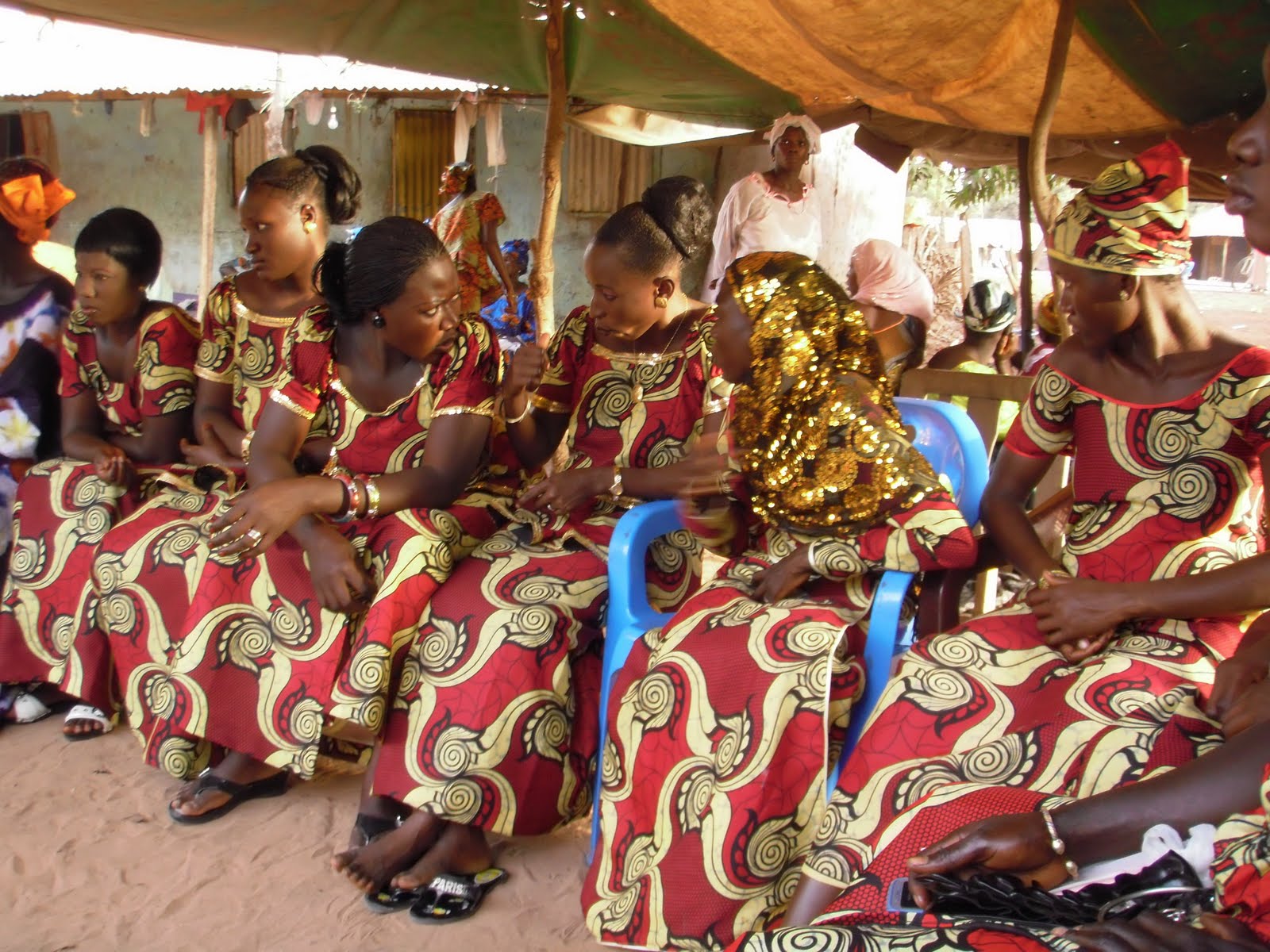 These are some of the girls from my tekla. We had asobe made. I'm sure I've told you before matching outfits are all the rage. We've been wearing it like crazy around town, but sadly no one has the photography skills to include me in a decent picture. Use your imagination.
 This is a big ol' pot of benachin at the Konteh Kunda naming ceremony, where both my toma and my mom's toma, plus two more kids who have no special toma-relationship with me, got to celebrate themselves.
Matching outfits again! These are Western Region PCVs at the All Volunteer conference. If you're not matching, you're not in the in crowd.
Sunday, April 11, 2010
Interhouse
I don't know if I wrote a post about this last year, but interhouse is one of my very favorite Gambian events, and I can't let it pass unnoticed (okay, well it already passed, but better late than never, right?).
What is interhouse? Only the finest modern childrens sporting event in West Africa. At interhouse, the Upper Basic School divides itself into four houses, sort of like Harry Potter. This year the high school in the next village also competed, so we had a total of five teams. Then, they all run races and do other track and field-type events. (Side note: they also do this at the lower basic school, but instead of foot races, they do relays like the "carry a bucket of water on your head" race. Hilarious.)
What makes interhouse so amazing is the drama. This isn't any old American-style tournament. In this competition, if you're losing the race you might as well dramatically pass out in the middle of the track, showing the audience how difficult running 100 meters truly is. There are no losers, only drama queens.
When a competitor passes out, it's the job of the Red Cross Club to run to them with the stretcher. As you might imagine, the Red Cross Club was very busy. In each race, they had at least one person they needed to put on the stretcher. The "exhausted" racer would lie in the stretcher for a minute, and then be cured.
I worked at the judges table for interhouse, recording which teams won the races. Runners would come with cards showing how many points they got for each race, then as soon as they gave the cards to the judges they would collapse and roll in the dirt, practically having seizures to show you how exhausted they are, until they get up and straighten their wigs out. That's right, the girls run in their fancy wigs. You have to look smart for interhouse. All the girls who just come to watch wear their western-style made-in-China best. This means tight tight tight plaid jeans, synthetic tops, and other clothing items that might have them mistaken for street walkers in America. But in Gambia, they're looking smart. And the runners also take the opportunity to show off, running in miniskirts and other "work out" gear. A little bit of running, a lot of high quality performance art.
What is interhouse? Only the finest modern childrens sporting event in West Africa. At interhouse, the Upper Basic School divides itself into four houses, sort of like Harry Potter. This year the high school in the next village also competed, so we had a total of five teams. Then, they all run races and do other track and field-type events. (Side note: they also do this at the lower basic school, but instead of foot races, they do relays like the "carry a bucket of water on your head" race. Hilarious.)
What makes interhouse so amazing is the drama. This isn't any old American-style tournament. In this competition, if you're losing the race you might as well dramatically pass out in the middle of the track, showing the audience how difficult running 100 meters truly is. There are no losers, only drama queens.
When a competitor passes out, it's the job of the Red Cross Club to run to them with the stretcher. As you might imagine, the Red Cross Club was very busy. In each race, they had at least one person they needed to put on the stretcher. The "exhausted" racer would lie in the stretcher for a minute, and then be cured.
I worked at the judges table for interhouse, recording which teams won the races. Runners would come with cards showing how many points they got for each race, then as soon as they gave the cards to the judges they would collapse and roll in the dirt, practically having seizures to show you how exhausted they are, until they get up and straighten their wigs out. That's right, the girls run in their fancy wigs. You have to look smart for interhouse. All the girls who just come to watch wear their western-style made-in-China best. This means tight tight tight plaid jeans, synthetic tops, and other clothing items that might have them mistaken for street walkers in America. But in Gambia, they're looking smart. And the runners also take the opportunity to show off, running in miniskirts and other "work out" gear. A little bit of running, a lot of high quality performance art.
Friday, March 19, 2010
Tekila: A biweekly dance party
A few months ago a few of my friends in village told me they were organizing a Tekila, and I decided to join for the many perks it includes. A Tekila is sort of like an old-fashioned lottery/savings account mixed with a dance party. My group is made up of 35 girls about my age (which means that I'm basically one of the few not toting around a baby) who get together on the first of the month and on the 15th for an hour of drinking attaya and juice, singing and dancing. For me, it's a great way to get more integrated with a part of my village I don't really work with, and therefore don't know as well. For about two hours every two weeks, we shake our butts and bang on plastic bidongs in celebration.
The point of the Tekila isn't just to dance. When the group was formed, we all wrote our names on slips of paper. At every meeting, one name is drawn. This person is the lucky recipient of the prize money. Each girl contributes 25 dalasis each meeting, which means that when your name is drawn you get a lump sum of 875 dalasis. If you do the math, over the course of all the meetings you contribute exactly as much as you win, so you're not really coming out on top. But in this society saving is really hard, so while it's easy for each woman to find 25 dalasis to pay every two weeks, it would be rare to find someone who saved that 25 dalasis on their own initiative until they had 875 dalasis. So this is like tricking the women into saving. Keep contributing 25 dalasis, and at some point you'll find a large sum of money in your pocket. The women can do whatever they want with the money. Their only commitment is to host the next meeting at their house and supply the snacks and beverages.
The funny thing about my Tekila is that every single time, without fail, at least one hour of the meeting is spent arguing over how late fees should be charged, how many meetings you're allowed to miss, blah dee blah blah. Always the exact same subjects each time. Nothing is ever done, and frankly nothing really needs to be done because everyone pays up eventually. But it's tradition. We have a Tekila mother who is supposed to iron these things out and remind us that we came to party.
And party is in fact what we do. Everyone sits in a circle and people bang on various cooking utensils converted into instruments. Every girl is supposed to dance a few times in the middle of the circle during the meeting (which at first was kind of embarassing for me... I can dance in a club, but dancing African-style while someone bangs on some pastic with a stick is a little beyond me. I got over it though. I had to.). Some of the ladies are pretty bad dancers, but there are a few who can really shake it. African dancing is all about jumping up and down and sticking your butt out. One girl named Kaddy is the best. We had some excitement at the last meeting when she was dancing in the circle and her bin-bin broke. Binbin are basically a sexual accessory that every single Gambian woman wears. It's a string of beads your wear around your waist and the bigger they are, and the more they clack together, the sexier it is. But no one is ever supposed to see your bin-bin, and it's pretty scandalous if someone's are showing. Kaddy's bin-bin broke as she was dancing and beads just rained down out of her skirt. It was like a pinata, with all the (few) single ladies rushing to pick up the beads. Turns out collecting fallen bin-bin beads is a good luck charm, like catching the bouquet at a wedding. My friend Hawa collected a bunch because she wants to get married now now. A lot of the girls gave their beads to me... Not sure how I feel about that really.
Cross your fingers that I win the money the next time. I'm getting anxious for some profit!
The point of the Tekila isn't just to dance. When the group was formed, we all wrote our names on slips of paper. At every meeting, one name is drawn. This person is the lucky recipient of the prize money. Each girl contributes 25 dalasis each meeting, which means that when your name is drawn you get a lump sum of 875 dalasis. If you do the math, over the course of all the meetings you contribute exactly as much as you win, so you're not really coming out on top. But in this society saving is really hard, so while it's easy for each woman to find 25 dalasis to pay every two weeks, it would be rare to find someone who saved that 25 dalasis on their own initiative until they had 875 dalasis. So this is like tricking the women into saving. Keep contributing 25 dalasis, and at some point you'll find a large sum of money in your pocket. The women can do whatever they want with the money. Their only commitment is to host the next meeting at their house and supply the snacks and beverages.
The funny thing about my Tekila is that every single time, without fail, at least one hour of the meeting is spent arguing over how late fees should be charged, how many meetings you're allowed to miss, blah dee blah blah. Always the exact same subjects each time. Nothing is ever done, and frankly nothing really needs to be done because everyone pays up eventually. But it's tradition. We have a Tekila mother who is supposed to iron these things out and remind us that we came to party.
And party is in fact what we do. Everyone sits in a circle and people bang on various cooking utensils converted into instruments. Every girl is supposed to dance a few times in the middle of the circle during the meeting (which at first was kind of embarassing for me... I can dance in a club, but dancing African-style while someone bangs on some pastic with a stick is a little beyond me. I got over it though. I had to.). Some of the ladies are pretty bad dancers, but there are a few who can really shake it. African dancing is all about jumping up and down and sticking your butt out. One girl named Kaddy is the best. We had some excitement at the last meeting when she was dancing in the circle and her bin-bin broke. Binbin are basically a sexual accessory that every single Gambian woman wears. It's a string of beads your wear around your waist and the bigger they are, and the more they clack together, the sexier it is. But no one is ever supposed to see your bin-bin, and it's pretty scandalous if someone's are showing. Kaddy's bin-bin broke as she was dancing and beads just rained down out of her skirt. It was like a pinata, with all the (few) single ladies rushing to pick up the beads. Turns out collecting fallen bin-bin beads is a good luck charm, like catching the bouquet at a wedding. My friend Hawa collected a bunch because she wants to get married now now. A lot of the girls gave their beads to me... Not sure how I feel about that really.
Cross your fingers that I win the money the next time. I'm getting anxious for some profit!
Subscribe to:
Posts (Atom)

